
| Diagonale | 2026 | Recap |
Sold-out cinemas and higher attendance at the politically charged and discussion-rich 29th edition of the festival in Graz
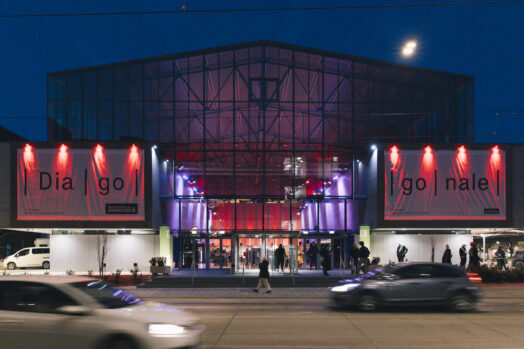
Opening Diagonale ’26 © Harald Wawrzyniak
The Festival of Austrian Film took place in Graz for the 29th time from March 18 to 23, once again under the direction of Dominik Kamalzadeh and Claudia Slanar and raffirmd its role as a cornerstone of Graz’s cultural scene and of Austria’s film and cultural industries. 149 film productions were shown at Diagonale ’26, 77 of them as Austrian or world premieres. The film competition, in which Austria’s most highly endowed film awards were presented by international juries, once again formed the centerpiece of the 2026 festival edition, featuring 82 films across the categories of feature, documentary, short, and innovative film. As part of Diagonale, the Franz Grabner Award, the Carl Mayer Screenplay Awards, and the Thomas Pluch Screenplay Awards were traditionally presented, along with the Mabacher Award for the first time.
“Our view is that, over the past few days, Diagonale has once again shown what spaces of cultural concentration can generate: a public sphere in productive tension. It was a political edition, one that not only allowed for discourse but actively sought it out — across individual films, within the resonance created by multiple works, and time and again beyond the cinema itself. We were delighted by the full auditoriums — especially for films that challenge audiences. And by the unexpected alliances that emerged: loose associations, fleeting agreements, sometimes friendships. Festivals are places where community is not only visible, but first takes shape — and in doing so continually expands. Our thanks go to the filmmakers, producers, and distributors who once again placed their trust in us. And last but not least, thanks to our extraordinary team, who made our Diagonale possible. We are already looking forward to the anniversary edition in 2027!” — Dominik Kamalzadeh and Claudia Slanar, Festival directors
The Festival of Austrian Film opened on March 18 at Helmut List Hall with the Austrian premiere of Rose by Markus Schleinzer. David Scheid hosted the opening evening of the 29th Diagonale in Graz, under the direction of Dominik Kamalzadeh and Claudia Slanar, with spirited moderation. In addition to the director, members of the film team in attendance included actors Caro Braun and Marisa Growaldt, cinematographer Gerald Kerkletz, Alexander Brom, who co-wrote the screenplay, and producer Johannes Schubert. As part of the opening ceremony, the Grand Diagonale Acting Award 2026 for services to Austrian film culture was presented to Hilde Dalik in the form of an artwork created by Anita Leisz. Director Alexandra Makarová delivered the laudatory speech on behalf of the acting jury, praising Dalik’s courage, strength, and exceptional artistic integrity. Guests included Vice Chancellor Andreas Babler, Regional Councillor for Culture Karlheinz Kornhäusl, Mayor Elke Kahr, Vice Mayor Judith Schwentner, and City Councillor for Culture Claudia Unger. Trailer director Michael Gülzow and Billy Roisz, to whom Diagonale dedicated an extensive retrospective, also joined numerous filmmakers in celebrating the opening of the Festival of Austrian Film. Also in attendance were Werner Kogler (former Vice Chancellor and Member of the National Council), Cathedral Pastor Ewald Pristavec, hostess Kathryn List of the AVL Cultural Foundation, and Walburga Seidl from the Board of Steiermärkische Sparkasse.
A True Award Marathon
The heart of the festival was, as always, the competition: Austria’s highest endowed film prizes, worth a total of €128,500, were awarded by international juries on Monday evening, honoring the wide range of achievements involved in making a film. In addition, the Diagonale Audience Award, presented by Kleine Zeitung and endowed with €3,000, which had already been awarded at a pre-screening, was once again recognized. A total of 82 films were represented in the competition. As usual, the program featured feature-length and short fiction and documentary films, as well as innovative cinema. Seventy of the competition films celebrated either their Austrian or world premiere on Graz cinema screens during the festival, in the presence of the filmmakers.
Hosted by Susi Stach and Gilbert Handler, 20 film awards were presented in the largest auditorium of Annenhof Cinema in the presence of numerous filmmakers and foundation representatives, most notably the Grand Diagonale Awards of the Province of Styria for Best Feature Film and Best Documentary Film. In the presence of Regional Councillor for Culture Karlheinz Kornhäusl, Angela Summereder was honored for B wie Bartleby and Tolga Karaaslan for Baba, What’s Your Plan? City Councillor for Culture Claudia Unger presented the Diagonale Award for Innovative Cinema of the City of Graz to Georg Petermichl for Amature Enlightenment. All award winners received an artwork conceived and created by artist Anna Paul: the golden Diagonale nut, a life-size bronze sculpture of a nutmeg, small enough to fit into any trouser or skirt pocket — a companion for every occasion. The overview of the award winners and sponsors, as well as the jury statements, is available → here.
Also presented within the framework of Diagonale were the Franz Grabner Prize on Friday (Best Cinema Documentary: Grünes Licht by Pavel Cuzuioc) and the Kodak Analog Film Award, which went to Franz Quitt and Laura Ettel for Closed for the Virus Break. On Sunday evening, the Mabacher Award was presented for the first time as part of the festival; the prize for Best Inclusive Film also went to Baba, What’s Your Plan?, the documentary feature debut of Tolga Karaaslan. On Monday morning, the Carl Mayer Screenplay Awards were presented (main prize to Peter Pflügler for the treatment of Hans – or – Don’t Bury Me in the Grave of My Father), as well as the Thomas Pluch Screenplay Awards (main prize to Markus Schleinzer and Alexander Brom for Rose). In the afternoon, the Kleine Zeitung Audience Award for the festival’s most popular film was presented to The Stories by Abu Bakr Shawky.
FILMSPECIALS AT DIAGONALE ’26:
| Position | Hlynur Pálmason |
Icelandic director and visual artist Hlynur Pálmason – most recently in Cannes with the tragicomedy The Love That Remains – came to Graz with a comprehensive retrospective of his work and offered insights into his filmmaking process in a masterclass.
| Position | Billy Roisz |
Diagonale 2026 dedicated a comprehensive retrospective, including a live performance, to filmmaker, musician and performer Billy Roisz, who has been active since the late 1990s.
| Film History | Girls Will Be Boys |
Women in Trouser Roles: SYNEMA’s film-historical special explored gender fluidity and cross-dressing in German-language cinema of the interwar period.
| Film History | New Uncertainties – Austrian Documentary Cinema in the 1990s |
A film-historical search for traces in seven programmes from 30 years ago in domestic documentary filmmaking, a time of change and new beginnings.
| And in the Middle | A Wirtshaus |
And in the Middle is a new annual film and discussion series held as part of Diagonale, dedicated to exploring places beyond urban centers.
| Special | Duisburg Film Week |
To mark its 50th anniversary, the renowned German documentary film festival came to Graz, presenting films from its history that unsettle, provoke, and challenge.
| In memoriam | Emily Artmann |
A small homage in memory of the poet, editor, and filmmaker.
| Portorož meets Graz |
A new collaboration with the Festival of Slovenian Film.
SUPPORTING PROGRAM OF DIAGONALE ’26.
With the support of the festival’s main sponsor, Steiermärkische Sparkasse, in-depth talks and discussions were held under the titles Nachspann and Nachspann EXTRA – for cinema that extends beyond the screen – including with Markus Schleinzer, Caro Braun, Klaus Fried, Harald Friedl, Billy Roisz, and Anat Stainberg.
The festival’s industry gathering, the Film Meeting, drew strong audience interest and focused, among other topics, on children’s and family films. It also featured updates and news from the industry, including on reducing barriers in film, the founding of #we_do!, the selection process for the International Feature Film Oscar, and the Austrian Film Institute’s Green Filming Report. At the Forum in the Heimatsaal, the programme also included a special edition of Let’s Talk About Scripts! with Maria Petschnig and Thomas Brooks, the FC Gloria Salon complete with a choral interlude, and a performative concert with Billy Roisz, dieb13, Martin Brandlmayr, and Karolina Preuschl.
Traditionally, the exhibition at Kunsthaus Graz was also closely tied to the festival: Michael Gülzow, creator of the Diagonale ’26 trailer series, presented his exhibition The Gate to Unreality there, while Claudia Larcher’s Less is more, more, more was on view at Akademie Graz. This year, Street Cinema Graz was able to hold its short-film walk through the Lend district without rain, and the Cinema Next Breakfast Club invited young filmmakers under the title Breadless Passion(s) to share experiences, ask questions, and think ahead together. Festivalgoers could wind down the festival days both in a relaxed atmosphere at the Diagonale Bar in the Volksgarten Pavilion — hosted by Eule Bier — and at the many premiere parties held across Graz.
The wonderful festival team once again made a significant contribution to the success of the festival in 2026 and deserve the greatest thanks!