


| Forum |
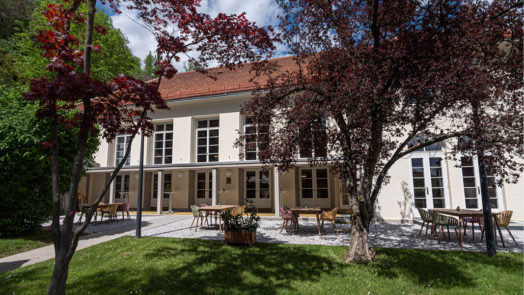
Panel discussions, the Diagonale Film Meeting and the award ceremonies for the Franz Grabner Prize, the Mabacher Award, the Carl Mayer Screenplay Prize and the Thomas Pluch Screenplay Prize take place in the event series Forum at Heimatsaal in the Volkskundemuseum at Paulustor. The adjoining terrace and garden invite you to get into conversation before or after the events, make contacts or simply take a break from the hustle and bustle of the festival.
© Ijob Brandstätter
Diagonale Film Meeting
Thursday, March 19, 9.30 a.m. to 5 p.m.
Free admission
The Diagonale Film Meeting, the festival’s two-day industry gathering, brings current topics and industry updates to the stage of the Heimatsaal on the first day. The content comes not only from the festival, but also from the industry itself. The Film Meeting sees itself as a contact point for the latest questions and topics and at the same time aims to provide impetus for current and future developments within the film industry. This year, the focus will be on children’s and family films, among other topics. On the second (non-public) day, measures and processes will be considered and discussed in detail in groups.
Funded by: FISAplus – Filmstandort Austria, FERNSEHFONDS AUSTRIA, Fachverband der Film- und Musikwirtschaft
Supported by: Creative Europe Media Desk Austria – MEDIA, Canon, ÖFI, AAC Austrian Association of Cinematographers, Cinematographinnen Women* Cinematographers Network
The Diagonale Film Meeting is certified as a Green Meeting by Diagonale according to the criteria of the Austrian Ecolabel.
Presentation of the Franz Grabner Prize
Saturday, March 20, 11 a.m.
Free admission
For the Best Cinema Documentary and the Best Television Documentary, each endowed with €5,000, donated by AAFP and ORF. Initiated and organized by the Grabner family, AAFP, Film Austria, ORF, and Diagonale in memory of ORF journalist Franz Grabner (1955–2015). The award recognizes filmmakers who use their medium in an ethically and morally responsible and credible manner.
With the support of the Federal Ministry for Housing, Arts, Culture, Media, and Sport, FERNSEHFONDS AUSTRIA, dok.at, and the Film Commission Graz.
Jury: Antje Boehmert (producer & author, DE), Jakob Brossmann (filmmaker & stage designer, AT), Karin Moser (film scholar, AT)
Keynote speech: Nava Ebrahimi
The Franz Grabner Award ceremony is certified as a Green Event by Diagonale according to the criteria of the Austrian Ecolabel.
FC Gloria Salon
Under the Skin: Body, Power, and Trauma
Saturday, March 21, 3.30 p.m.
Free admission
Film work is body work. How can cinematic approaches to resistance and self-empowerment be found when bodies have been marked by restriction across generations? FC Gloria invites you to a discussion with directors Magdalena Chmielewska (Teresa’s Body) and Belinda Kazeem-Kamiński (Nursery Rhymes. (Holy) Water) and art historian Rose-Anne Gush (TU Graz). In times of resurgent authoritarian systems, restriction once again affects the body in the form of violence, whether everyday, structural, or personal. How can cinematic work intervene in these changes, expand the scope for action—and ultimately reclaim it? A panel discussion about what we carry beneath our skin—and how we can make it visible.
The event will open with a performance by the Gloria Choir, conducted by Eva Prosek.
Moderator: Dalia Ahmed (ORF / FM4)
Curated by: Klaudia Kiczak and Lisa-Marie Gotsche
Performance/Concert: Tripping On Electrons
Billy Roisz, dieb13, Martin Brandlmayr, Karolina Preuschl
Saturday, March 21, 9 p.m. (admission: 8 p.m.)
Free admission, pay as you wish
The performance is understood as both an archaeological and futuristic gesture: earlier works are not shown retrospectively, but reactivated as living substance. A cinematic collage of 26 years of experimental image and sound work by Billy Roisz provides the starting point—fragments of early work are woven into a multi-layered, vibrant tapestry of images and sound: analog video noise meets digital image streams, optical feedback dissolves into shimmering fields of color, rhythmic impulses correspond with silence, distortion, and feedback.
This cinematic score serves as a visual score for a group of musicians with whom Roisz has collaborated repeatedly over the past decades.
Video Score, Electronics: Billy Roisz, Turntables: dieb13, Drums: Martin Brandlmayr, Voice, Electronics: Karolina Preuschl
Let’s talk about scripts!
Diagonale Spezial mit Maria Petschnig zu Beautiful and Neat Room
Sunday, March 22, 2 p.m.
Free admission
Even the tiniest apartment in New York is a precious and expensive commodity, making subletting a survival strategy. Beautiful and Neat Room develops from the filmmaker’s many years of flat sharing in New York into a social comedy that debunks stereotypes with hints of horror film.
Let’s talk about scripts! invites screenwriter and director Maria Petschnig and co-writer Thomas Brooks to a conversation about the film’s screenplay and dramaturgy, as well as the fictionalization of autobiographical material.
Moderator: Nina Kusturica
In cooperation with the Drehbuchforum Wien.
Mabacher Award Ceremony
Followed by a screening of the award-winning film
Sunday, March 22, 6 p.m.
Free admission
For the best inclusive film, with a prize of €5,000.
The film award is intended to preserve the memory of activist Martin Habacher (1977–2019), strengthen inclusive film culture, and anchor non-discriminatory visual language. The award goes to an outstanding film
that represents people with disabilities inclusively and thus breaks down barriers in society.
With the support of the Federal Ministry for Housing, Arts, Culture, Media and Sport, the Austrian Film Institute and the Vienna Film Fund.
Jury: Sybille Bauer-Zierfuß (filmmaker, AT), Simone Hart (cinematographer, AT), Yuria Knoll (actress, AT)
Information on accessibility on site:
→ Accessible toilet
→ Elevator to the 1st floor and step-free access -> Sign language interpretation (ÖGS)
→ Induction loop
Further support with questions about accessibility via office@mabacher-award.com
Presentation of the Carl Mayer Screenplay Awards and the Thomas Pluch Screenplay Awards
Monday, March 23, 11 a.m.
CARL MAYER SCREENPLAY AWARDS
For an anonymously submitted fictional or documentary treatment suitable for cinema on the theme of TEMPO. Prize money: €15,000 (main prize) and €7,500 (promotional prize), sponsored by: Cultural Department of the City of Graz.
Jury: Felix von Boehm (producer, DE), Sebastian Höglinger (jury chair, AT), Klemens Hufnagl (cinematographer & screenwriter, previous year’s winner, AT), Alexandra Makarová (screenwriter & director, AT), Françoise von Roy (dramaturg, DE)
THOMAS PLUCH SCREENPLAY AWARDS
Grand prize, worth €12,000, for the best screenplay for a feature-length cinema or television film. In addition, the jury’s special prize for the best screenplay for a feature-length cinema or television film with particularly outstanding aspects, worth €7,000, and the prize for the best screenplay for short or medium-length cinema films, worth €3,000.
Donated by the Federal Ministry for Housing, Arts, Culture, Media, and Sport. In cooperation with the Austrian Screenwriters’ Association.
Jury AT: Jacob Groll (screenwriter & director), Marie Luise Lehner (screenwriter & director), Joana Scrinzi (editor)
Jury int.: Lorenz Dangel (composer & musician, DE), Kyra Scheurer (dramaturge & curator, DE), N. N.