


| Position | Hlynur Pálmason |
A PROFOUND SENSE OF PLACE
By Sarah Lutton
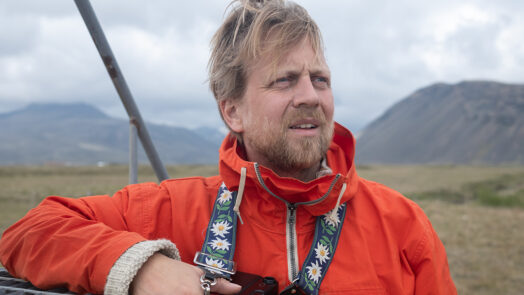
Hlynur Pálmason © Hildur Ýr Ómarsdóttir
Celebrated Icelandic filmmaker and visual artist Hlynur Pálmason is a creative polymath. His visual and aural worlds are curated with an artist’s eye and ear. From his graduation short, A Painter (En maler, 2013), to his most recent medium length film, Joan of Arc (Jóhanna af Örk, 2025), his work exhibits a harmony of vivid imagination and a deep engagement with the texture of the natural world. Underscored by a profound sense of place, Pálmason’s work is at once visually rich and yet also characterised by creative exactness and a sense of economy. His artistic mentality is curious and observational, playful and humane, at times maximalist and yet also spare, unhurried and never overwhelming, always leaving space for viewer contemplation; a particular mentality towards filmmaking, which critic and New York Film Festival programmer Justin Chang elegantly describes as “observational spareness”. (1)
Pálmason’s film and video work has featured in official selection and garnered numerous awards at major international festivals including Cannes, Berlin, Toronto, Locarno and San Sebastián. He studied directing at the Den Danske Filmskole (DFS)/National Film School of Denmark, graduating in 2013, having formed many important creative connections including that with his longtime editor, Julius Krebs Damsbo. Pálmason lived in Denmark for several years, working on collaborative Danish-Icelandic projects before returning to Iceland.
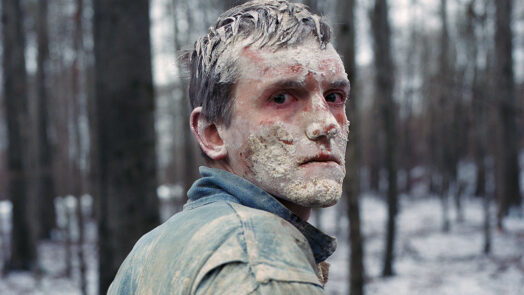
Still from Winter Brothers © Hlynur Pálmason
Shot in mesmerizing black and white and located at sea somewhere off the dark, snow-capped Icelandic coast, the synopsis for Pálmason’s early career short film, Seven Boats (Sjö bátar, 2014), reads “We are out in the open sea, a man is fighting for his life. He is surrounded by seven boats.” (2) This reflective film offers a meditation on mankind’s struggle with connection and empathy, a tension similarly at the heart of his debut feature, Winter Brothers (Vinterbrødre, 2017), a savagely beautiful exploration of the routines, habits, and rituals of two limestone quarry-worker brothers, in which for brother Emil (Elliott Crosset Hove), human connection and intimacy, however much desired, are painfully absent. Mainly shot on 16mm in Faxe, a small town on the Danish island of Sjælland, Winter Brothers features spare, open storytelling, coupled with episodes of disorientating sound and abstract visuals, creating a strikingly visceral impression of constricted lives lived in punishing surroundings, where tension and violence simmer close to the surface. Pálmason has opined that watching film can be like listening to music, offering individual emotional experiences rather than one prescribed ‘meaning’. (3) And, the experience of entering the hermetic world of Winter Brothers is a deeply sensual one -in partnership with editor Julius Krebs Damsbo, Pálmason fashions sound, image and mood into a symphonic experience. There is imagination and there is hope, and a personal odyssey may be inferred, but Pálmason’s storytelling is expansive rather than prescriptive, inviting viewers to experience, engage and draw their own conclusions.
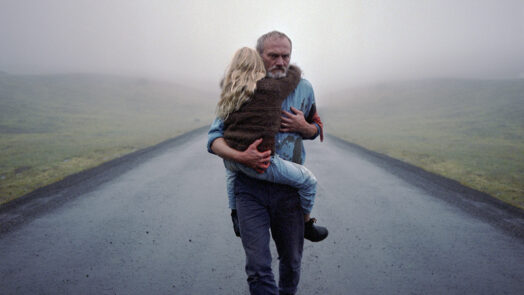
Still from A White, White Day © Hlynur Pálmason
Pálmason’s second feature, A White, White Day (Hvítur, hvítur dagur, 2019), shot on wide Super 35 format, opens with a static camera capturing time passing and seasons changing in a remote Icelandic town. A man constructs a house on a lonely plot, punctuated by sporadic visits from family members, often fleetingly observed by local Icelandic horses. The housebuilder is Ingimundur (Ingvar Sigurdsson), a recent widower and the local town’s police chief. He is debilitated by grief, and increasingly alienated from others, apart from his granddaughter (played by Pálmason’s daughter Ída Mekkín Hlynsdóttir), with whom he has a warm and devoted relationship. An accidental discovery about his wife sparks an obsessive pursuit for truth and some kind of understanding. There are elements of the thriller in the modus operandi of Ingimundur’s investigations, but there is also something deeply otherworldly in both his environment and his revelations. A white, white day is explained to be “when the separation between the land and the sky is indistinguishable and the dead speak to the living.” Hypnotic images highlight the beauty and strangeness of Iceland’s breathtaking landscape, while Sigurdsson’s towering performance reveals the interior devastation of a man consumed by loss yet opened to the power of transformation.
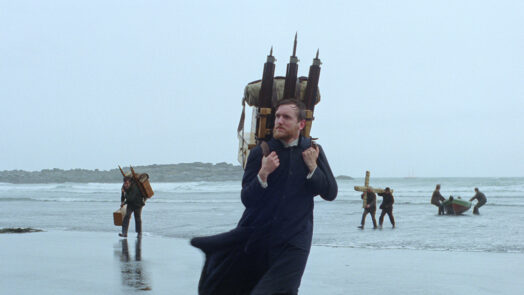
Still from Godland © Hlynur Pálmason
2022 saw the premieres of Pálmason’s short film/video installation, Nest (Hreiður) at the Berlin Film Festival, and later, his third feature, Godland (Vanskabte Land / Volaða Land), at Cannes. The stark beauty and harshness of nature, its movement and sound are, again, key elements of both pieces. Nest, set in contemporary Iceland, is an observational story spanning several seasons of siblings’ (played by Pálmason’s children) building of a tree house, their toils and joyfulness in tempo with the rhythms of weather and time. The historical drama Godland, set in the late 19th Century, is, conversely, a story of hubris in the face of God and nature. Lucas (Elliott Crosset Hove), a young Danish priest, travels to a remote part of Iceland (a Danish dependency at the time) ostensibly to build a church and photograph its people. Far from assimilating or offering any kind of recognisable Christian love or charity in his new Icelandic home, Lucas’s interactions are transactional, domineering and dangerously aggressive. Shot in old Academy format (whose 1.33:1 ratio creates a squarer image), nature and landscape are presented through deeply textured images and soundscapes, functioning as characters and shaping the story as much as providing an environment for its setting. They are formidable antagonists to Lucas’s blind imperialism and his wanton disregard for his natural and human companions. Godland also incorporates moments from Pálmason’s time-lapse piece, Lament for a Horse (Harmljóð um hest), documenting the decay of an Icelandic horse, a creature which has been fundamental to the shaping of modern Iceland. It is a specific homage to nature and place, and a beautifully poignant reminder that all shall return to dust.
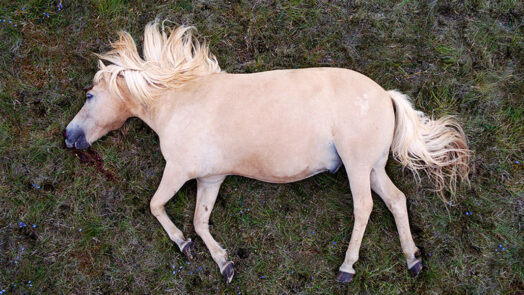
Still from Lament for a Horse © Hlynur Pálmason
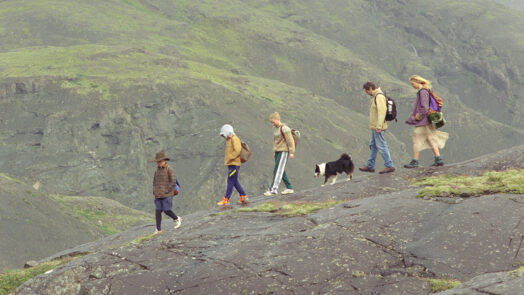
Still from The Love That Remains © Hlynur Pálmason
Again, time has an almost physical presence in The Love That Remains (Ástin sem eftir er, 2025), which documents a year in the life of a family in Iceland as the parents negotiate separation. Witty, playful and surprising, the rhythms of the seasons dictate and underscore the progression of lives which are the ‘same but different’. Very relatable family sequences often featuring the scene-stealing (and Cannes Palm Dog-winning) family dog, Panda, are punctuated with mysterious, light-hearted episodes. Time moves on, separation is sad, but change brings new perspectives. Pálmason’s second film of 2025, the linked timelapse piece, Joan of Arc, is a story again shaped by the seasons, the landscape and natural elements. (4) An armoured mannequin is constructed by children for archery target practice on a wild Icelandic coastal knoll. Over time the knight-like figure is buffeted by their arrows and the extreme weather. The mannequin deteriorates, but rather than disappearing through neglect, a surprise turn mysteriously suggests that there could be new life beyond what has been endured. A perfect encapsulation of the heart of Pálmason’s work; a deep engagement with the texture of the natural world and the progression of time.
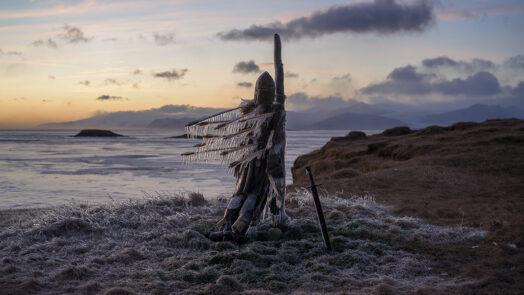
Still from Joan of Arc © Hlynur Pálmason
Footnotes / References:
(1) Justin Chang, The Love That Remains post-screening discussion with Hlynur Pálmason, 63rd New York Film Festival, 10 October 2025.
(2) Seven Boats, synopsis, Hlynur Pálmason, https://www.hpalmason.com/text
(3) Interview with Hlynur Pálmason. Sarah Bradbury, The Upcoming, 22 October 2025 https://www.youtube.com/watch?v=tlIDSuZJ0Cc
(4) In The Love That Remains the children (played by Pálmason’s children) use a knight-like mannequin outside for target practice. The children in Joan of Arc are again played by Pálmason’s children. Although not strictly ‘concurrent’ projects, filming on The Love That Remains began in 2017 and Joan of Arc was shot over three years.
About the author:
Sarah Lutton specialises in Nordic film and is a longtime contributor to the BFI London Film Festival programme, where she is currently a Selection Committee Member. She has written on, curated seasons and events, and hosted career interviews with Nordic filmmakers including Liv Ullmann, Thomas Vinterberg and Lukas Moodysson. She also works with BAFTA (British Academy of Film and Television Arts) on their new talent mentorship programme, and with the British Council’s Film Team supporting UK films and filmmakers internationally.
