


| Position | Billy Roisz |
PICNIC IN SINE WAVE VALLEY.
ON THE ARTIST BILLY ROISZ’S CINEMA AND SOUND WORK
by Stefan Grissemann
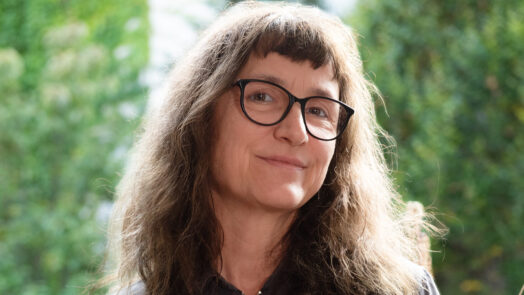
Billy Roisz in Vienna in October, 2025 © Diagonale / Lisbeth Kovačič
Sometimes all it takes is to wire the machine wrong to avoid the danger of simply following what others have already done. So, at some time toward the end of the last millennium, while preparing for a concert, Billy Roisz decided to mis-channel the audio signals of her music into the video input of her video mixer to generate abstract visuals triggered directly by acoustic impulses.
And rather than seeing the resulting phenomenon as merely image interference, all the twitching lines, grids, and electric flashes of colored light, Roisz recognized the unusual, malleable beauty of these fragile patterns. She found her instrument. Since then, she has been producing—constantly varying and refining her methods—spectacular, often hypnotically pulsating works, some entirely abstract, others underpinned by real images; a kind of beautiful noise for brain, eyes, and ears. The astonishingly physical effect of these moving image objects is intentional. “I want my works to dock directly on the synapses and bodily sensations,” says the Viennese artist, who sees herself as not only a film and video artist, but also live performer, sound artist, and musician: she releases albums, tailors electronic soundtracks to silent film classics, and brings improvised drone and noise compositions to the stage.
Despite all the pleasure of the color radiating from the screens, there is always something dark, vaguely abysmal in Roisz’s films. The nervously rhythmized red-green-yellow circles in the programmatically titled work HAPPY DOOM (2023) are on the verge of being sucked into a black hole. The underground of “dangerous” images and intrusive sounds, from which the artist originates, remains present in her productions—as an imprint, idea, and notion; it gapes like a distant but bottomless pit.
Roisz’s play with color is informed by art history, neuroscience, and psychophysiology: the precisely dosed retina experiment Who’s Afraid of RGB (2019), for example, alludes to red, green, and blue color fields, and from a distance, also to the paintings of Barnett Newman and Mark Rothko. do they speak color? (2022) relies on distorted and artificially colored real images to create an enigmatic science-fiction film that looks as though aliens did the post-production.
First and foremost, says Roisz, it’s “about perception experiments on visual and auditory levels. What happens to what’s heard when directly and analogue to it, I see something—and vice versa?” She places audio and video signals, that is, the medium itself, at the center of her aesthetic approach. Analogue video technology, she explains, is built on interlaced lines and grids onto which “sound frequencies are modulated.” The signals that are used in this way, “become both audiovisual sculpture and the tool itself.” She likes the raw, material aspect of her “glitches and noises, the perfect raw material for my audiovisual sound sculptures.” Chance and improvisation are very much a part of her work, but as she remarks with a smile, the decisions of the machines are not on equal footing with her own: “I am, after all, the tamer in my electronic zoo.”
For her most recent picnic, Billy Roisz—via the film title—has transformed Hieronymus Bosch’s old garden of delights and torment into a new, synthetic animal park, a site of electrical pleasures: In Garden of Electric Delights (2025) the foreign images and sounds are released from their slumber in the circuits of the vintage devices that Billy Roisz constructs, connects, and operates.
About the author:
Stefan Grissemann has headed the culture section of the Austrian news magazine profil since 2002; book publications on Ulrich Seidl, Edgar G. Ulmer, Elfriede Jelinek, Robert Frank, Peter Kubelka, and Michael Haneke. His texts on contemporary cinema have appeared, among others, in the FAZ, Kunstforum, and New York’s Film Comment magazine.