


| Film History | New Uncertainties |
Austrian Documentary Cinema
in the 1990s
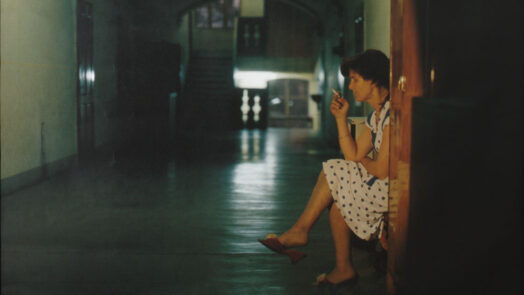
Postadresse: 2604 Schlöglmühl by Egon Humer © Prisma Film
The 1990s can be seen as a phase of historical transition: political, social, and cultural orders were being readjusted. The collapse of the bipolar world order, global establishment of neoliberal economic and governmental models, and nascent digitization generated a situation of underlying insecurity. Longstanding visions of the future lost their validity, while new forms of political articulation and cultural representation emerged. In this sense, we understand the 1990s as a period in which history itself, also in the cinema, could be conceived anew: as a moment when the relationship of experience, memory, and representation itself became the subject of critical reflection.
In Austria, the geopolitical shifts overlapped with specific domestic political and social upheavals. A structural transformation in industry, already foreseeable since the 1970s, increasingly called into question the labor movement’s traditional organizational forms. While the social democratic economic policies of the Kreisky era were able to temporarily cushion this development, the situation intensified in the 1980s with the Social Democratic Party of Austria’s loss of an absolute majority and the simultaneous rise of the Freedom Party of Austria. In a process similar to that of international role models, such as New Labour, class-based political narratives gave way to those centered on individualization, performance, and social mobility.
At the same time, Austria was also directly affected by the consequences of upheavals in Eastern Europe. The collapse of Yugoslavia and the war in Bosnia led to migration movements that contemporized the existing debates about belonging and difference. Against this backdrop, also the meaning of historical concepts shifted: memory was no longer understood as a reliable compass, but as something constantly retold from differing perspectives. Archives no longer appeared as neutral sites of preservation, but as systems of order with blind spots; and history was understood as a narrative that is performatively produced. Questions about belonging, difference, and contradictory identities stepped to the forefront.
These shifts also found resonance in Austrian cinema of the 1990s. A new generation of filmmakers began to question established narrative and representational forms. For this year’s historical program, eleven films have been selected that pursue these upheavals with formal finesse—documenting them, reflecting on them, or simply making them visible in the first place. With two exceptions, they are documentary films whose diversity points to a central development: the borders of the documentary became porous, and questions about what can be considered documentary representation itself became the object of aesthetic inquiry. Hybrid forms, essayistic approaches, and subjective perspectives added to or subverted classical representation patterns.
Gerhard Benedikt Friedl’s Knittelfeld – Stadt ohne Geschichte (1997) is paradigmatic in this regard. The violent genealogy of a family unfolds almost exclusively on the soundtrack, while in calm long shots, the camera presents a seemingly untouched small town. Between image and narration, a void emerges in which history becomes tangible as absence. Totschweigen (1994) by Margareta Heinrich and Eduard Erne likewise refrains from reconstruction, focusing instead on the persistent effects of silence surrounding the Rechnitz massacre: on excuses, ruptures, strategies of not saying anything. Egon Humer’s Postadresse: 2640 Schlöglmühl(1990) documents the closure of a paper factory and the biographical upheavals that follow the loss of a job; in Aufzeichnungen aus dem Tiefparterre (2000, filmed between 1993 and 1999), Rainer Frimmel radicalizes this perspective even more in a fragmentary, subjective form that refuses any narrative of progress.
Nikolaus Geyrhalter’s Das Jahr nach Dayton (1997) portrays Bosnia after the peace agreement in long, static takes—a landscape suspended between reconstruction and standstill, in which the experience of war continues to reverberate. Draga Ljiljana – Liebe Ljiljana (2000) by Nina Kusturica combines autobiographical reflection with the search for lost origins. The images oscillate between idyll and fractured memory; the attempt to process war and flight is articulated also in a sense of placelessness.
In all these films, a central movement of the 1990s becomes manifest: critical perspectives aim to expose the conditions of representation rather than reveal new certainties. Visibility and omission, narration and silence find themselves in a field of tension. History appears as contested terrain, where memory, meaning, and power are continually renegotiated.
As its starting point, New Uncertainties takes the complex of themes in these and many other films. It understands the works as living documents that yield new meanings over time—of the social and societal upheavals, of changes in youth culture, and of how we view the visual worlds of the Yugoslav wars. In these works, what was still inconspicuous at the time they were made, becomes visible.
Curated by Dominik Kamalzadeh and Claudia Slanar. Diagonale would like to thank the Filmarchiv Austria, the ORF Archive and the Austrian Film Museum for their support.
As a complement to the Film History section, filmfriend, the libraries’ streaming service, presents additional Austrian documentary films from the 1990s, including works by directors such as Ruth Beckermann, Nikolaus Geyrhalter, and Michael Glawogger. In addition, more than 40 films from previous editions of the Diagonale are available to stream at → filmfriend.at/collections/diagonale