



| Film History | Girls Will Be Boys |
GENDER FLUIDITY AND CROSS-DRESSING IN INTERWAR CINEMA
By Brigitte Mayr
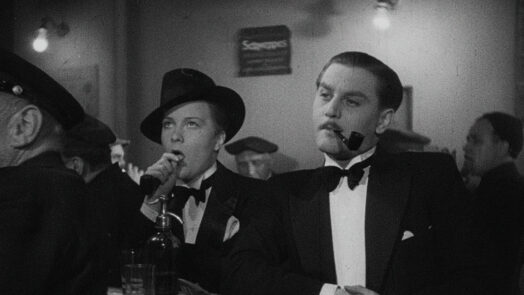
Viktor und Viktoria by Reinhold Schünzel © Friedrich-Wilhelm-Murnau-Stiftung Wiesbaden
From one minute to the next, they must decide. Shedding skirt, blouse, and hat, they slip into shirt, suspenders, and suit, tie on a necktie, and lace up solid shoes. Hiding their curls or bob, they give their hair a strict side part—slicked down with thick pomade—and take great pains in gesture and expression to depict what society expects of a man. The very same social environment that, in times of social crisis and unemployment, doesn’t offer the three young women in the films a chance of finding work commensurate with their abilities.
One of the women, Friedl, speaks perfect English and French, applies to offices and businesses, but gets one rejection after another—until she comes up with the idea of putting on her brother’s uniform when applying for the advertised job as a page at the Dalmasse Hotel. After her own clothes are stolen, also Eva sees no other way to escape impending homelessness than to languish away as a newspaper boy. And the actor Susanne struggles just as much for a job: thanks to a clever stage charade, she is introduced as a singing and dancing Spanish woman, until she rips off her wig at the last moment and with a deep voice, reveals herself as a man.
Dressing as a man allows the women, who have no other chance to earn money—except as prostitutes—to make a living. In an act of self-empowerment, they become the rascal with freckles, the elegant young man in a tailcoat, and the dashing androgynous page. The main aim of this role reversal is the income, the guarantee that they are able to take care of themselves—although in the background of these romantic comedies, the love interest always becomes noticeable; and in the end, at the side of the “girls as boys” are, in most cases, handsome, elegant gentlemen, with all the qualities a woman could wish for.
In the real world, the women in male roles meanwhile reflect the economically challenging interwar period. For quite a while already, the division into typical male and female workplaces had been impossible to maintain; professions had seemingly been conquered, with women conductors, mail carriers, auxiliary police officers, innkeepers, and shop owners running their own businesses. The social critique in the three films shown deals with evictions, hunger, poverty, the theme “Looking for work, will do anything!”, the hardships of gaining a foothold in the theater, and the hierarchical structures that men and women are subjected to in their working lives.
But above all, it is the three magnificent actors Dolly Haas, Franziska Gaál, and Renate Müller who lead to their success. In the 1930s, each of them could have had a major career in German-language cinema, but the Nazis crushed this chance. Renate Müller (1906–1937), one of the most popular stars of the era, had her reputation ruined and repressive measures imposed that drove her to drug and alcohol addiction, and ultimately to her death. Dolly Haas (1910–1994) was forced to emigrate, first to England, then to the U.S., where she could only find her footing on Broadway, but not in the film industry. Franziska Gaál (1903–1972) was able to escape her fate as a Jew, and was hired in Hollywood, but her talent was wasted in B-movies. She died impoverished and completely forgotten in New York.
Cinema, however, preserves these three amazing performers, intact, in a glass sphere, not having aged in any way. It offers them in their struggle for survival as modern, autonomous, intelligent figures of identification (for us) and allows us to share in their exuberant zest for life—regardless of whether as men or women.
Curated by SYNEMA
Brigitte Mayr, Michael Omasta
About the author:
Brigitte Mayr, born in Linz, studied theater and German at the University of Vienna, alongside training in bookselling and qualification as a scholarly antiquarian. She is managing director and head of research of SYNEMA – Society for Film and Media, (co-)conceiver of symposia and film events, and (co-)editor and author.